
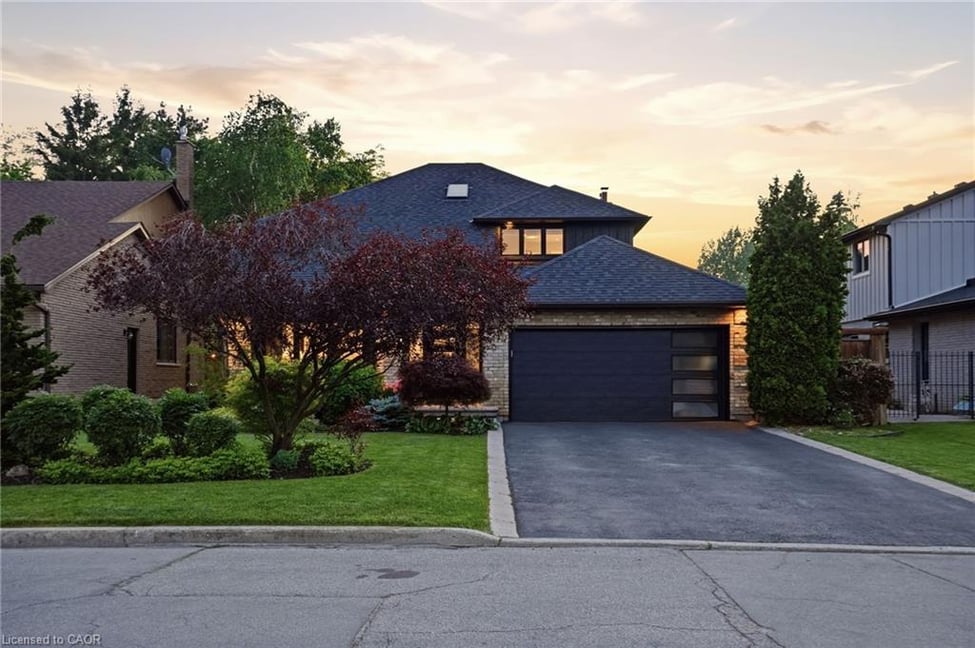
What a Detached House Really Costs Per Month in Stoney Creek and Hamilton
The list price tells you what a house costs to buy, not what it costs to own. A detached house comes with several separate bills, plus upkeep that a condo fee would otherwise cover. Buyers who budget only for the mortgage get caught.
This guide goes through each cost in turn: the mortgage (with worked examples), property tax, utilities, insurance and upkeep.
The mortgage
The mortgage is the biggest bill, and your down payment changes it a lot. In Canada, the minimum down payment is 5% of the first $500,000 of the price plus 10% of the portion above that, for homes priced under $1.5 million. At $1.5 million or more, the minimum is 20%.
If you put down less than 20%, you need mortgage default insurance. With a down payment between 5% and 9.99%, the CMHC premium is 4.00% of the loan (as of October 2026). It is normally added to the mortgage, so you pay interest on it. Ontario charges sales tax on the premium, and that tax cannot be added to the mortgage. Our guide to closing costs covers it.
The three prices below are illustrations, not market averages. The assumptions are a 4.5% five-year fixed rate (a round figure close to the best five-year fixed rates available in early October 2026) and a 25-year amortization. The minimum-down column includes the 4.00% premium.
| House price | Minimum down payment | Monthly payment with minimum down | Monthly payment with 20% down |
|---|---|---|---|
| $700,000 | $45,000 | About $3,770 | About $3,100 |
| $850,000 | $60,000 | About $4,545 | About $3,765 |
| $1,000,000 | $75,000 | About $5,325 | About $4,430 |
In these examples, the minimum down payment costs about $670 to $895 more every month. Both columns use the same rate for simplicity, though lenders often price insured and uninsured mortgages differently. Run your own figures with our mortgage calculators, and see our guide to first-time buyer programs for help with the down payment.
Property tax
Property tax is billed separately by the City of Hamilton. It is the home's assessed value, set by the Municipal Property Assessment Corporation (MPAC), multiplied by the combined municipal and education tax rates. The assessed value is not the price you pay. Ontario assessments are still based on values as of January 1, 2016.
You do not need to estimate this bill. Every listing shows the actual annual tax for that house. Divide it by twelve.
Utilities
In a house, you pay every utility yourself.
- Heating. Natural gas is the most common heating source in Ontario. Enbridge Gas is the gas distributor in Hamilton.
- Electricity. Alectra Utilities delivers electricity in Stoney Creek and most of urban Hamilton.
- Water, wastewater and stormwater. The City bills these through Hamilton Utilities Billing, which took over from Alectra in April 2026.
Ask the seller for the last twelve months of bills. Check the listing for rented equipment too, such as a water heater, which adds a monthly bill.
Home insurance
Home insurance is not required by law, but most mortgage lenders require it before they lend. In a condo, the corporation insures the building and you insure the inside of your unit. In a house, the whole building and the lot are yours to insure. Get a quote on the specific address before your offer becomes firm.
Upkeep and replacement
A freehold house has no condo fee and no reserve fund. You are the reserve fund. Over time you pay for the roof, the furnace and air conditioner, windows, the driveway, eavestroughs, lawn care and snow clearing.
A common budgeting rule of thumb is to set aside about 1% of the home's value each year. On an $850,000 house that is $8,500 a year, or about $710 a month. It is a rule of thumb, not a fact about any particular house, and an older house will need more. A home inspection tells you the condition of the big items.
Putting it together
For any house you are serious about, add up five monthly lines: the mortgage payment, the property tax from the listing, the utilities from the seller's bills, the insurance quote and your upkeep allowance. That total is the monthly cost of the house. The mortgage payment alone is not.
Lenders run their own test. Federally regulated lenders, such as banks, must check that you could afford the payments at a higher qualifying rate: 5.25%, or your actual rate plus two percentage points, whichever is higher (as of October 2026). At a 4.5% rate, you qualify at 6.5%. Passing does not show that the other four lines fit your budget. A mortgage broker or lender confirms what you qualify for, and our guide to how much house you can afford explains more.
Who should be careful with these numbers
- Buyers whose total only works at today's rate with the minimum down payment. You have little room for a higher rate at renewal or a failed furnace. Leave yourself a cushion.
- Buyers moving from a condo or a rental. You may never have paid for a roof or a furnace. Those bills arrive in the thousands, not in monthly instalments.
A detached house is not right for every budget. If the upkeep line is what breaks the total, a townhouse or condo may suit you better for now.
Browse houses for sale
- Houses for sale in Stoney Creek
- Houses for sale in Stoney Creek Mountain
- Houses for sale in Fifty Point
Frequently Asked Questions
How much is property tax on a house in Hamilton?
It depends on the home's MPAC assessed value and that year's tax rates. Every listing shows the actual annual tax, so use that figure.
What is the minimum down payment on a house in Ontario?
It is 5% of the first $500,000 plus 10% of the portion above that, for homes under $1.5 million. On an $850,000 house, that is $60,000.
Do I need mortgage insurance with less than 20% down?
Yes. The premium is normally added to your mortgage. With CMHC, it is 4.00% of the loan for a down payment between 5% and 9.99% (as of October 2026).
What is the mortgage stress test in Canada?
Federally regulated lenders must check that you could afford your payments at 5.25% or your actual rate plus two percentage points, whichever is higher.
How much should I budget for maintenance on a house?
A common rule of thumb is about 1% of the home's value a year. The age and condition of the roof, furnace and windows matter more than any formula.
Want to work through the monthly cost of a specific house? Get in touch and we will go through it with you.
This guide is general information, not mortgage, tax or legal advice. Rates, premiums and rules change, so confirm your own numbers with a mortgage broker or lender.